Let’s say you’re hiring for a critical role on your team. Candidate A has a Master’s degree from a prestigious university, but little hands-on experience. Candidate B has a diploma, certificates from a number of specialized short courses, and two years of proven, measurable impact, but in a different industry.
Everything else constant, who gets the job?
While the votes might be split on this, such situations show clearly the challenges and struggles faced by both employers and job seekers, and why the degree vs skills conversation is becoming increasingly important.
Over the years, the number of graduates in Kenya has been increasing.
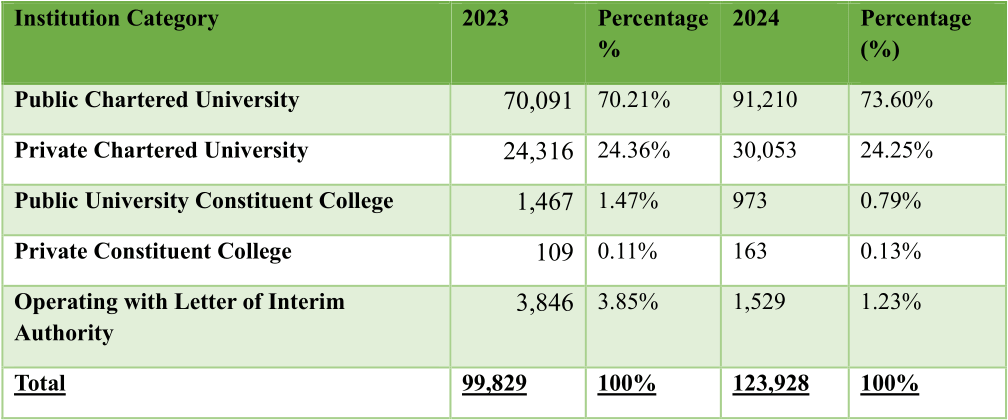
Source: Commission for University Education
Despite businesses actively hiring, unemployment is still high, with 62% of employers saying graduates lack the skills the job market needs.
This raises an important question for recruiters and hiring teams: Are university degrees the best way to identify capable talent, or has the job market evolved beyond what traditional education can provide? The growing degree vs skills debate in hiring reflects this shift.
How Degrees Became the Default Hiring Signal
For decades, degrees played a crucial role in hiring decisions. This is because university degrees communicated a few important things to employers:
- Foundational knowledge in a specific field
- Commitment and discipline to complete a long-term project
- Standardized evaluation by accredited institutions
Then, organizations started receiving hundreds, even thousands, of job applications. This is where degrees became a practical shortcut. They provided a simple way to narrow the candidate pool.
Where Degree-based Hiring Starts to Break Down
With the competitive nature of business, the demand for agile, tech-literate, and emotionally intelligent talent increased. Meanwhile, the supply struggled to keep pace.
One explanation for this struggle is that curriculum approval and accreditation can take years. Give it three years for instance, add four years of student learning and assessment, and within these seven years, some industry needs may have evolved beyond what was taught.
According to the World Economic Forum’s Future of Jobs Report 2025, 63% of employers say skill gaps are a major barrier to transformation. This is largely due to:
- Rapid technology changes
- Graduates having limited exposure to real workplace environments during study
- Education systems evolving more slowly than industry needs
- Increasing demand for practical and digital skills
This shows that academic learning and workplace readiness don’t develop at the same pace.
The Shift Toward Skills-based Hiring
The 2023 FKE Skills Needs Survey Report shows that 43.8% of jobs require a bachelor’s degree. However, a growing number of employers are also acknowledging the value of technical and vocational training.
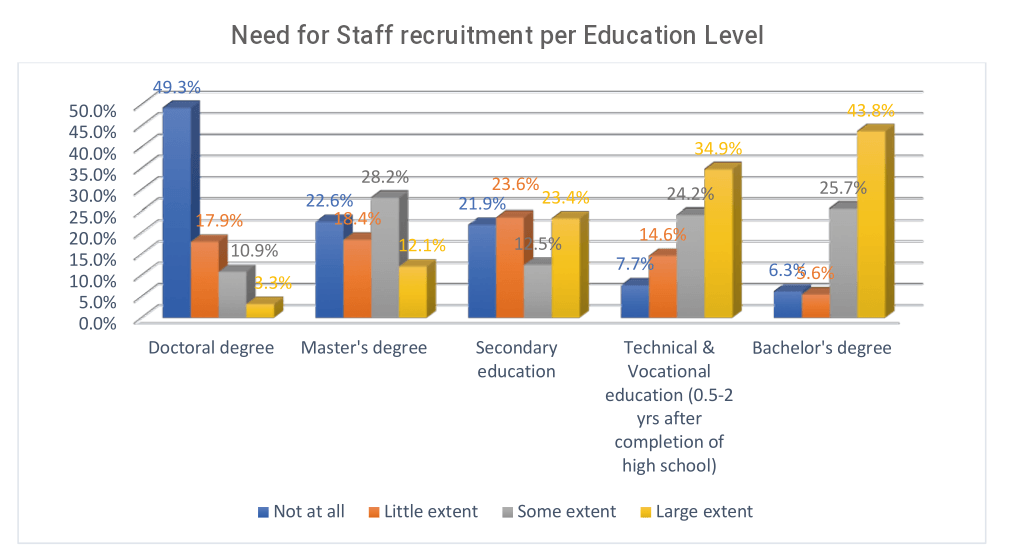
Source: Federation of Kenya Employers
This shows that employers are increasingly becoming open to skills-based hiring, considering alternative learning paths. These paths can include professional certifications, Technical and Vocational Education and Training (TVET), apprenticeship, and independent project portfolios.
Embracing skills-focused recruitment can paint a clearer picture of how well a candidate can perform on a job. With a focus on skills and hands-on experience, employers can get benefits such as:
- Plug-and-Play agility – candidates who upskill through targeted diplomas and specialized short courses need less training and can contribute to ROI much faster.
- Proof of continuous learning – a collection of recent certificates or a portfolio of practical work shows that a candidate is continuously learning and practising what they learn. The quality of being self-taught, especially in the era of AI and rapid technological changes, can be invaluable in a candidate.
- Real-world problem solving – skills and experience show how a candidate can solve problems in the real world, e.g. delivering on a project when budgets are low or timelines are tight.
The Power of Transferable Skills
Even with skills-based hiring, many recruiters still look for candidates that have been in roles and industries similar to the ones they’re recruiting for. Yet, it’s possible that the best hire could be the one bringing a wealth of transferable skills from a different environment.
For instance, a project manager who has successfully handled the logistics of the events industry might possess the agile mindset needed to streamline operations in a tech startup. A customer success manager from the hospitality sector might have the level of client empathy needed in a B2B SaaS company.
As such, it’s important to not only prioritize skills over degrees, but also embrace creative thinking and innovativeness when recruiting. This way, we’ll be able to see how skills from one sector can apply to the roles we’re hiring for.
The Way Forward in the Degree vs Skills Debate
We shouldn’t delegitimize university degrees, but rather, give skills and experience the value they deserve. However, when hiring for highly specialized fields like medicine, law, and engineering, degrees should remain a non-negotiable foundation.
For most business roles today, e.g. marketing, business development, etc, we need to rethink our screening processes. We should be careful not to restrict our talent pipelines by requiring degrees for roles that realistically require a solid grasp of digital tools, and a few years of hands-on experience.
Here’s what a more balanced approach to hiring could look like:
- Consider skills and demonstrated ability, alongside academic credentials
- Recognize alternative learning pathways, not just prestigious universities
- Evaluate problem-solving ability
- Expand talent pools beyond traditional candidate profiles
On the other hand, learning institutions need to work on truly equipping their students according to the needs of the labour market.
Traditional teaching methods have predominantly emphasized technical skills, whereas employers increasingly value transversal skills such as communication, critical thinking, innovativeness, and adaptability, which cut across roles and sectors.
Dr. Ruth Njoroge, Director, Touchstone Pharmaceuticals
In a paper titled “Bridging the Skills Gap Through Academia: Can Company CEOs Be Part of the Faculty?”, Dr. Ruth Njoroge proposes collaboration between academia and industry. The idea is that if industry leaders can be integrated into academia through teaching roles, then curricula can be better aligned with the job market realities.
Such a collaboration could greatly help businesses get the skilled talent they need, especially as 39% of core job skills are projected to become obsolete by 2030.